
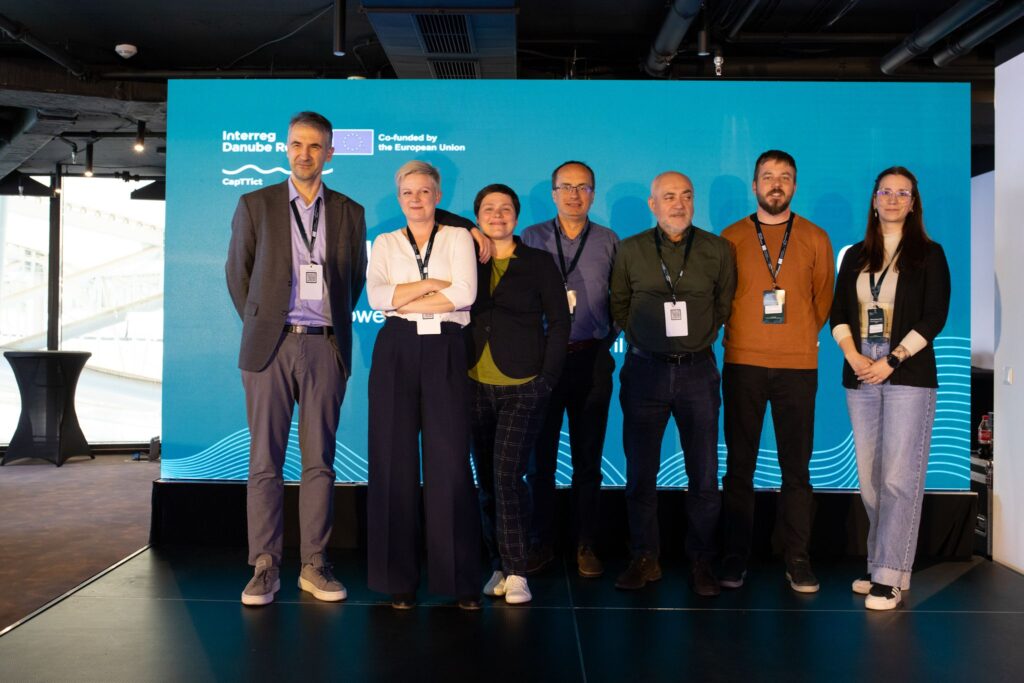
AI4Health.Cro took part in the European Digital Innovation Hubs Conference 2026 in Bratislava, joining European partners to discuss how digital innovation hubs can better support healthcare institutions, startups, SMEs and researchers working with AI and digital health solutions.
For healthtech innovators, access to testing, data, expertise and trusted partners is often just as important as the technology itself. That was one of the key messages AI4Health.Cro brought to the European Digital Innovation Hubs Conference 2026, held in Bratislava and organised by SAPIE Slovakia within the CapTTict project, alongside SAPIE Forum 2026.
The conference provided an opportunity for AI4Health.Cro to share what we have learned so far through our work as a European Digital Innovation Hub focused on artificial intelligence in healthcare and medicine.
The AI4Health.Cro team presented practical experience from several areas: how Test Before Invest works in real-world settings, how education can be structured for different user groups, and what it takes to organise a datathon around real challenges in healthcare.
These are increasingly important questions for organisations developing or adopting AI-based solutions in the health sector. For startups and SMEs, the challenge is often how to test a solution before making major investments. For healthcare institutions, it is how to work with digital innovation in a way that is secure, useful and aligned with real clinical needs. For researchers and public sector stakeholders, the question is how to connect expertise, data and infrastructure in a way that can lead to practical outcomes.

In Bratislava, discussions quickly moved to the issues that define the next stage of healthtech adoption: access to data, collaboration with healthcare institutions, support for startups whose solutions are relevant to the health sector, and the need to make EDIH services easier for new users to understand and access.
AI4Health.Cro also used the event to exchange experiences with Slovak, German and Romanian EDIHs, as well as with partners from the Interreg Danube Region project CapTTict, in which the Ruđer Bošković Institute and Mreža znanja d.o.o. are Croatian partners.
The exchange confirmed a common challenge across Europe: healthtech innovation needs more than strong ideas. It needs testing environments, access to relevant expertise, trust between innovators and healthcare institutions, and collaboration across sectors and borders.
For AI4Health.Cro, the conference was also a moment to connect European-level discussions with ongoing work in Croatia. The hub continues to onboard new users and prepare the AI4Health.Cro Summer School, and develop activities that help organisations test, improve and bring digital health solutions closer to real-world use.
The team is also finalising this year’s innovation competition, focused on AI in diabetes care, bringing together interdisciplinary teams working on practical solutions for one of the major public health challenges.
As AI in healthcare moves from promise to implementation, the focus is shifting. The key questions are no longer only about what technology can do, but also about how it can be tested, trusted, and used responsibly in real healthcare environments.
For AI4Health.Cro, this is where the work continues: building more access, more trust and more collaboration for the next generation of healthtech solutions.