
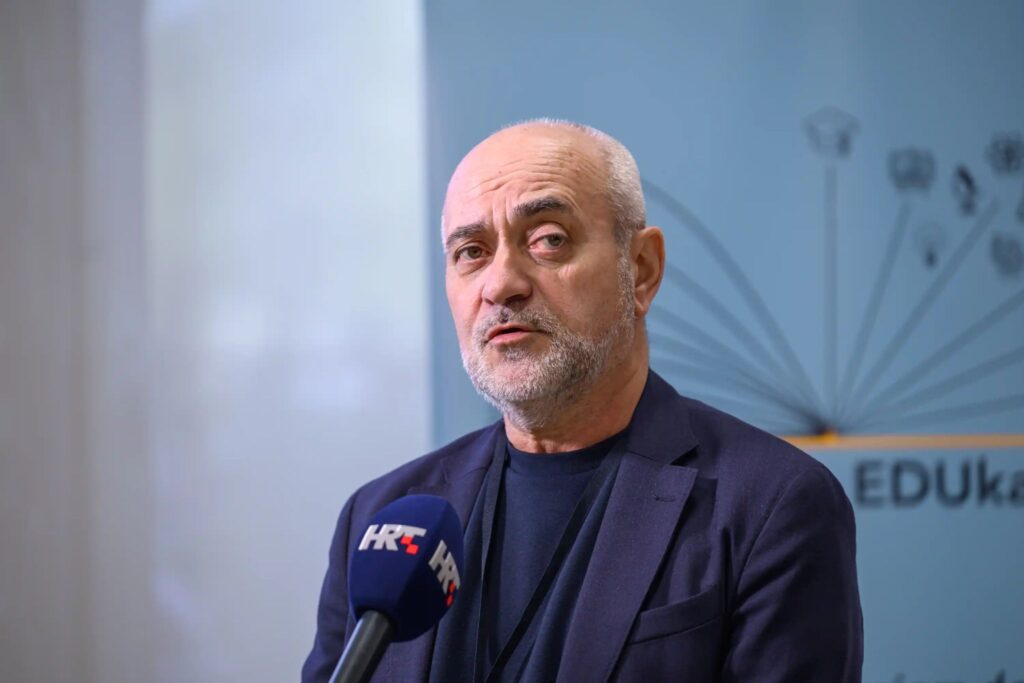
AI can help healthcare teams work smarter, but only if it is introduced with clear goals, strong structures and a focus on real benefit for patients and the healthcare system.
That was the key message shared by Dr Tomislav Šmuc, Head of Division and senior research scientist at the Ruđer Bošković Institute, and Science Coordinator of the AI4Health.Cro project, during the panel “Human + AI: How to build teams that work smarter — not harder”, organised by the Croatian Chamber of Economy.
As healthcare systems across Europe look for ways to use artificial intelligence in diagnostics, treatment planning, administration and patient support, the pressure to adopt new tools quickly is growing. But Dr Šmuc warned that AI should not be treated as a ready-made solution that can simply be added to existing systems.
“AI is not a plug and play solution,” he said, emphasising that meaningful implementation takes time, structure and a clear understanding of what the technology is expected to improve.
According to Dr Šmuc, the use of artificial intelligence in healthcare should be aligned with at least one of the core goals of healthcare: improving patient experience and treatment outcomes, advancing population health, or reducing costs for the system.
That distinction matters. In healthtech, innovation is often measured by technical performance — how accurate a model is, how fast a system works, or how much data it can process. In healthcare, however, the real test is whether a solution can help patients, support clinicians and fit into the realities of everyday clinical work.
For AI4Health.Cro, this is one of the central questions behind its work with SMEs, startups, healthcare organisations, researchers and public sector stakeholders. The aim is not to promote AI adoption for its own sake, but to support the development, testing and implementation of digital health solutions that are useful, trustworthy and aligned with real needs.
Dr Šmuc also highlighted the importance of interdisciplinary collaboration. Effective AI implementation in healthcare cannot be driven by technical experts alone. It requires cooperation between data scientists, software developers, clinicians, healthcare administrators and decision-makers who understand how the system works in practice.
This is especially important because healthcare is not a standard digital market. It involves sensitive data, complex workflows, professional responsibility, regulation, public trust and direct consequences for patients. In such an environment, successful AI depends as much on governance, communication and teamwork as it does on algorithms.
The discussion also connects closely with the mission of AI4Health.Cro as a European Digital Innovation Hub for artificial intelligence in healthcare and medicine. Through services such as testing, training, access to expertise, support in finding funding and “Test Before Invest” opportunities, AI4Health.Cro helps organisations assess whether their digital health solutions are technically sound, clinically relevant and ready for further development.
As AI becomes more present in healthcare, the challenge is no longer simply whether the technology is available. The real question is how to introduce it in a way that strengthens healthcare teams rather than adding complexity, supports better decisions rather than replacing professional judgement, and creates measurable value for patients and the system.
That is where AI4Health.Cro continues to focus its work: helping healthcare and technology partners build the foundations needed for responsible, useful and sustainable AI adoption.