
Croatian healthtech team Insulogic has developed an AI platform that could help doctors detect therapy non-adherence in type 2 diabetes early, combining predictive data analysis with automated patient follow-up.
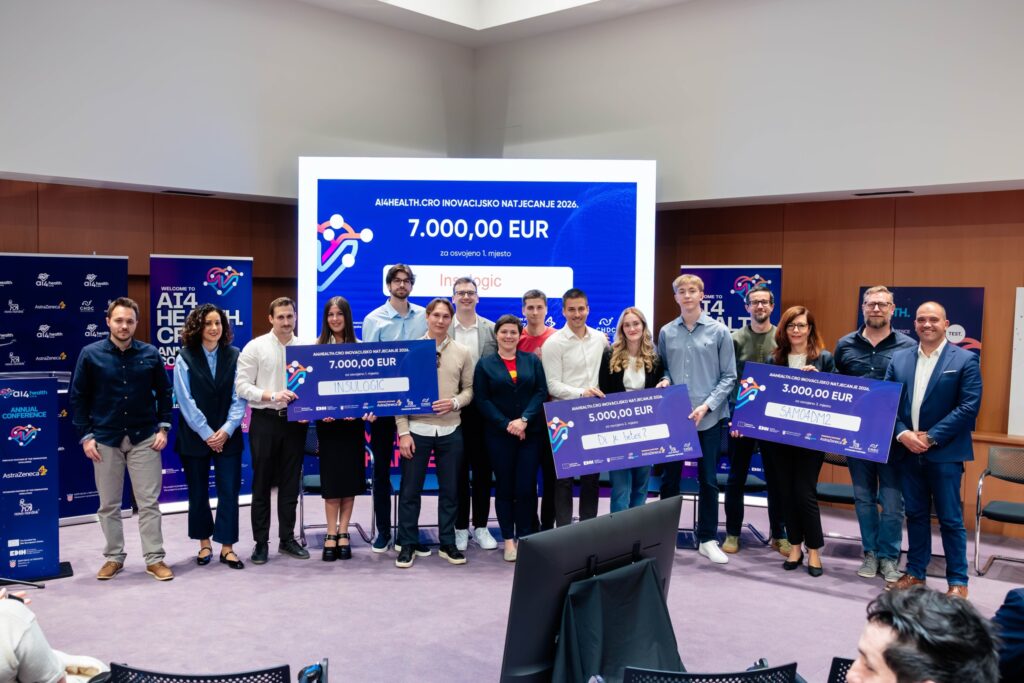
A Croatian healthtech team has won this year’s AI4Health.Cro Innovation Competition with an artificial intelligence solution designed to help doctors identify patients with type 2 diabetes who may be at risk of skipping their treatment.
The winning team, Insulogic, received the top prize of €7,000 for a platform that combines predictive analytics with an AI-powered voice assistant. The tool is designed to flag patients who may struggle to adhere to their prescribed therapy and to support doctors with timely, structured follow-up.
The competition, held under the theme “AI in the Service of Diabetes”, attracted 150 participants across 44 teams, making it the most competitive edition so far. After an initial selection process, 24 teams continued developing their solutions, with the top three presenting their prototypes at the AI4Health.Cro annual conference in Zagreb.
Insulogic brings together medical and technology expertise. The team includes Hrvoje Hrvoj, Josip Alpeza, Viktor Ivanić, Adrian Sallabi and Chiara Krtak. Its members combine frontline clinical experience, medical data analysis, and software development, reflecting one of the competition’s core aims: to bring healthcare professionals and digital innovators closer together.
At the centre of the winning solution is a predictive model that analyses 74 features from a patient’s medical history to assess the risk of treatment discontinuation. According to the team, behavioural patterns, such as the regularity of prescription pick-ups and gaps between medical visits, proved to be stronger indicators of adherence than clinical parameters alone.
Once patients at higher risk are identified, the second part of the platform comes into play – an AI voice application that contacts patients by phone in Croatian. It reminds them about their therapy, asks about difficulties or side effects, and sends the conversation summary to the physician through an administrative dashboard.
The aim is not to replace clinical judgement, but to reduce the burden on physicians by giving them a clearer, real-time overview of patients who may need additional support.
Second place went to Di je betes?, a team made up of Mark Jelinić, Adrian Grbac Lacković, Petar Jukić, Donna Keran and Marin Protulipac, which received €5,000. Third place and €3,000 went to SAMO4DM2, whose members are Ivica Škvorc, Lana Škvorc, Željko Sučić and Siniša Sambol.
The jury assessed the teams not only on the technical quality of their solutions, but also on their potential value for doctors, patients and the healthcare system. An added value of this year’s competition was that teams worked with real, anonymised health data in a controlled environment and under high data protection standards, with support from the Croatian Health Data Centre project led by the Croatian Institute of Public Health.
Dr Anja Barešić, AI4Health.Cro, project coordinator and Head of the Laboratory for Computational Biology and Translational Medicine at the Ruđer Bošković Institute, said the teams had shown that successful digital health innovation depends on understanding real clinical needs.
“Teams demonstrated that they were not thinking only about technology, but also about how their solutions could help doctors and patients in real-life settings. That is the purpose of AI4Health.Cro innovation competitions,” Barešić said.
She added that AI4Health.Cro has so far delivered €1.9 million worth of services to users, pointing to strong demand for support in developing, testing and implementing digital health solutions.
The competition was organised in partnership with AstraZeneca, as a premium partner, and Novo Nordisk Croatia, as a standard partner.
AstraZeneca said the record number of applications showed strong interest in developing solutions that could support people with diabetes in everyday disease management and treatment adherence.
“Competitions like this show how important partnerships are between clinicians, innovators, data experts and partners such as AstraZeneca, who recognise the value of innovation,” the company said. “We want to see more solutions like these move from idea to practice and become real support for doctors, patients and better healthcare.”
Novo Nordisk Croatia also highlighted the importance of combining medical innovation with digital tools that can help people manage chronic disease more effectively.
“We invest significantly in innovation and the development of innovative medicines, but we also actively support solutions that can help people living with diabetes improve disease control and reduce or delay complications,” said Mariko Shimizu, Director of Novo Nordisk Croatia.
She added that technology and interdisciplinary collaboration can open new opportunities for patients, for physicians seeking better tools to monitor disease, and for entrepreneurial teams developing new healthcare solutions.
For Croatia’s emerging digital health ecosystem, the competition highlighted a growing shift, that AI in healthcare is moving from abstract promise towards practical tools designed around patients, clinicians and the realities of everyday care.
