
From AI-powered diagnostics to digital mental health, our final conference brought together the people and technologies shaping healthcare’s future. After three years of supporting health innovation in Croatia, AI4Health.Cro is embarking on a new chapter, with two new consortium partners and another three years of EU funding.
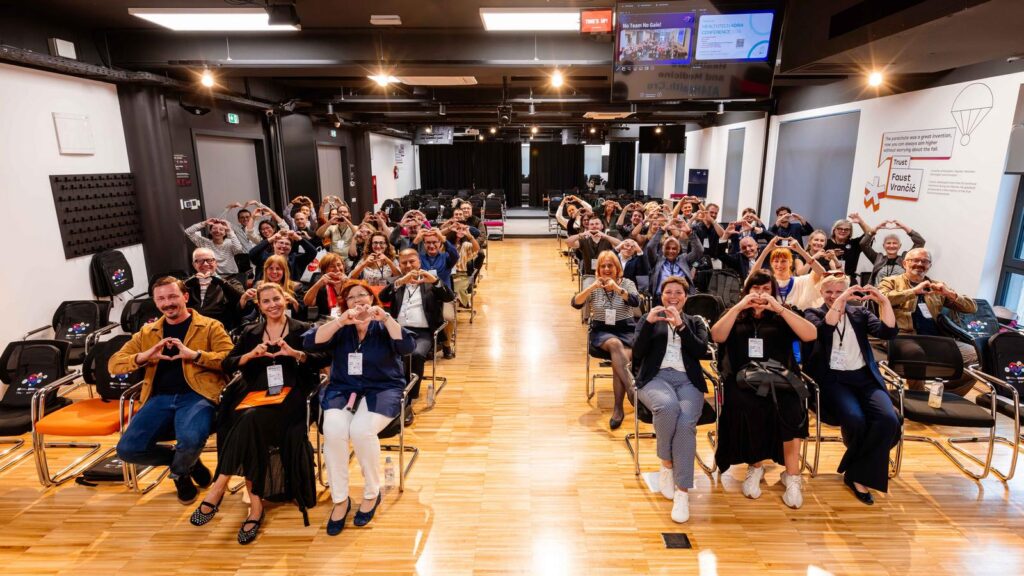
Three years of supporting healthcare innovation, around 100 Test Before Invest activities and 136 doctors trained. At its final conference in Zagreb, AI4Health.Cro brought together innovators, clinicians, key opinion leaders and healthcare decision-makers to share real-world success stories and explore what it takes to bring responsible AI into clinical practice.
What does it take to turn a promising health technology into a solution that healthcare professionals can use? Over the past three years, AI4Health.Cro has been helping startups, small and medium-sized enterprises (SMEs), healthcare providers and public-sector organisations (PSOs) answer that question.
Coordinated by the Ruđer Bošković Institute, our European Digital Innovation Hub (EDIH) has delivered more than 2,000 digital transformation services, combining technology testing, specialist training, access to finance and networking. At the heart of this work is a demand-driven approach: identifying what innovators and healthcare organisations need, connecting them with relevant expertise and helping them move towards implementation.
On 22 September, our final conference at Algebra Bernays University in Zagreb brought together the people behind these achievements. Six AI and digital health solutions were demonstrated live, alongside discussions involving healthcare professionals, industry experts, institutional representatives and technology entrepreneurs.
The event also marked the beginning of a new three-year phase of AI4Health.Cro, supported by the European Union’s Digital Europe Programme.
Test Before Invest: turning promising technologies into validated solutions
For healthcare innovators, developing a prototype is only one stage of a much longer journey. Access to reliable health data, opportunities for testing, clinical evidence, regulatory compliance and investment can all determine whether a technology progresses towards adoption.
Our Test Before Invest (TBI) services are designed to help organisations address these challenges before making significant financial commitments.
Over the project’s first three years, we supported approximately 100 innovation-testing activities, providing access to specialist expertise, research infrastructure, healthcare professionals and advanced computing resources.
Around one-fifth of our innovation-testing services involved technologies requiring substantial computing capacity, for which we facilitated access to national infrastructure and European supercomputing resources through EuroHPC.
At its final conference, held at Algebra Bernays University in Zagreb, six participating organisations showcased solutions at different stages of development, from early prototypes to products approaching commercialisation and those already on the market. The conference was opened by David M. Smith, Director of the Ruđer Bošković Institute, and Diana Krčmar, Head of the Innovation Sector at the Ministry of Economy.
David M. Smith emphasised that the project’s impact should be judged by the progress made by its users. Some technologies supported by AI4Health.Cro are now approaching commercialisation, while others have already reached the market.
“AI4Health.Cro has brought together research institutions, technology companies, startups, hospitals and the public sector in a field where bringing a product to market is particularly challenging. Through the Hub’s services, small and medium-sized enterprises have received support in developing competitive AI-based solutions. We are pleased that the Hub will continue its work for another three years,” said Diana Krčmar, Head of the Innovation Sector at the Ministry of Economy.
Zrinka Ujević emphasised that the adoption of artificial intelligence in healthcare requires high-quality data, infrastructure, skills and trust. “Artificial intelligence should support our doctors, not replace them. AI4Health.Cro is an excellent example of how European Digital Innovation Hubs connect the scientific community, the healthcare system and entrepreneurs,” she said.
Six user success stories, six healthcare challenges
Bringing a healthcare innovation from prototype to practical application requires access to data, clinical validation, regulatory compliance, infrastructure, financing and professionals equipped to use new technologies. These were precisely the challenges AI4Health.Cro addressed in its work with around 50 companies and 30 public-sector organisations.
“Our goal was not simply to deliver a service, but to help each organisation take the next tangible step forward,” said Dr Barešić. She added that approximately one-fifth of the innovation testing services involved solutions requiring advanced computing capabilities. To support their development, the Hub facilitated access to national infrastructure and European supercomputing resources through EuroHPC.
Our AI4Health.Cro Showroom placed users at the centre of the conference, allowing visitors to see technologies in action and speak directly with their developers.
The AI4Health.Cro Showroom gave visitors a chance to meet the teams behind six solutions and see how they respond to different needs in healthcare. Some were demonstrating working prototypes; others were showing products already in use. Together, they made the journey from testing an idea to putting it into practice much more tangible.
For TIS Grupa and Poliklinika Sabol, that journey begins with a video recorded on a smartphone. Their SENDD system analyses infants’ spontaneous movements to help identify potential neurodevelopmental risks earlier. Digicyte approached a different challenge in medical imaging: its ResoluX software enhances the resolution of digital cytology images, giving specialists a clearer view of the material they examine.
IVTECH demonstrated Curativa.ai, an assistant designed to help healthcare professionals work through medical information, find evidence-based recommendations and reduce routine administrative work.
WERXE’s PrivacyMark addressed the organisational side of digital healthcare, helping teams manage data protection documentation and cybersecurity requirements.
The showroom also extended beyond clinical software. Plasma Glow presented EEYA, a working prototype of a home skincare device using hybrid cold-plasma technology.
Psychological Centre Juranić invited visitors to try a brief digital self-assessment and learn about its MentalBoost approach to guided psychological self-help.
Visitors could ask the developers what they had tested, what they had learnt and what still stood between their solutions and wider use. Those conversations captured the purpose of AI4Health.Cro’s Testing Before Investing support: giving teams access to expertise and testing opportunities while they work out their next step.
Connecting key opinion leaders, clinicians and healthcare decision-makers
Healthcare innovation depends on more than technical performance. It requires engagement with the professionals, institutions and decision-makers responsible for evaluating, introducing and using new technologies.
Our final conference brought these perspectives together.
Representatives of the European Commission, national ministries and research institutions joined clinical experts, industry representatives and entrepreneurs to discuss the barriers to AI adoption in healthcare.
Clinical perspectives formed an important part of the programme, including discussions involving healthcare professionals from University Hospital Centre Sestre milosrdnice and University Psychiatric Hospital Vrapče.
By bringing recognised expert voices and key opinion leaders together with SMEs, startups, researchers and public-sector stakeholders, AI4Health.Cro facilitates knowledge exchange and creates opportunities for partnerships that can extend beyond individual projects.
The discussions addressed challenges that remain central to digital health: access to high-quality data, clinical validation, the GDPR and AI Act, cybersecurity, professional trust and implementation readiness.
From digital skills to confident clinical adoption
Building digital skills among healthcare professionals has been another central part of our work.
Across 176 educational activities, AI4Health.Cro has supported knowledge-sharing and capacity-building among organisations at different stages of digital maturity.
A particularly important achievement has been our collaboration with the Croatian Medical Chamber. Through two training cycles, 136 doctors participated in three specialised courses covering data and AI, technological infrastructure and digital systems, and healthcare information systems.
The conference session Future-Ready Doctors explored how demand-driven training can strengthen clinicians’ digital competencies and support the responsible adoption of new technologies.
Ivan Bekavac of the Croatian Medical Chamber and Tomislav Šmuc of the Ruđer Bošković Institute discussed the experience of this collaboration and the importance of sustained professional development as AI becomes increasingly relevant to clinical practice.
Secure health data and responsible AI
Access to high-quality health data is essential for developing and evaluating AI-based healthcare solutions. Making those data available securely and responsibly remains a significant challenge.
Through three annual Innovation Challenges, AI4Health.Cro piloted the use of anonymised healthcare data in controlled environments and developed an initial model for a secure data-processing environment.
At the conference, our data team presented a white paper on the secondary use of health data, drawing on experiences gained throughout the project’s first three years.
The paper outlines recommendations for researchers, healthcare providers, public institutions and technology companies, particularly in the context of preparations for the European Health Data Space.
These findings contribute to wider discussions on responsible AI, data governance and the infrastructure needed to support a sustainable European digital health ecosystem.
Building on three years of collaboration
AI4Health.Cro now enters a new three-year phase, with the Ruđer Bošković Institute continuing as coordinator and two new partners joining the consortium.
We also thank the Faculty of Engineering at the University of Rijeka, Feelsgood Capital and the Zagreb Innovation Centre (ZICER) for their contributions to the project’s first phase.
As part of the European Digital Innovation Hubs network, we will continue connecting healthcare organisations, SMEs, researchers, investors and recognised expert voices, supporting the exchange of knowledge and the development of new partnerships.
Our next phase will build on what we have learnt: helping innovators test before investing, strengthening digital skills, supporting access to expertise and finance, and creating the conditions for responsible AI technologies to move towards real-world healthcare applications.