
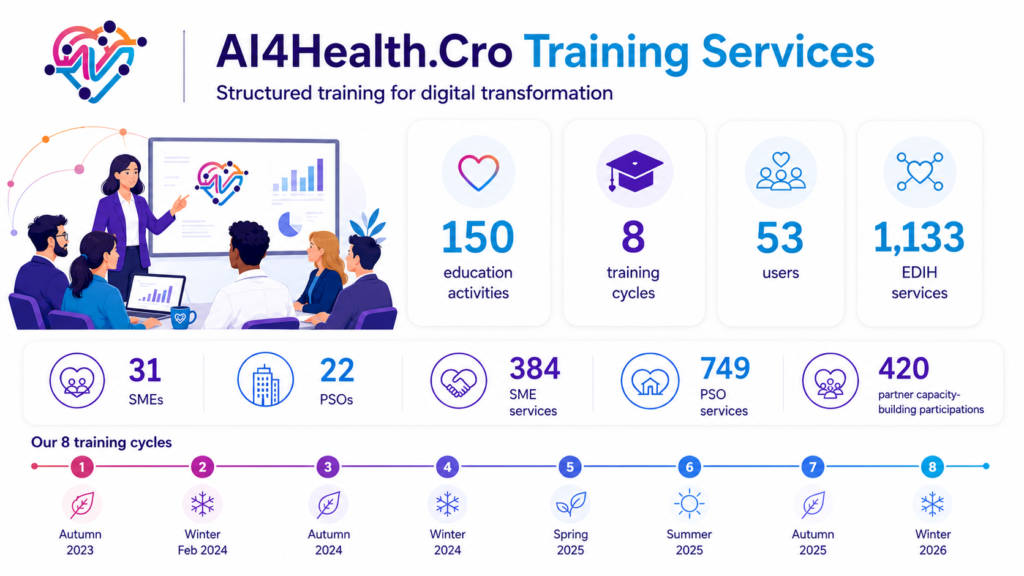
Between April 2023 and May 2026, AI4Health.Cro delivered 150 education activities across eight training cycles, providing 1,133 EDIH services to SMEs and public-sector organisations.
Digital transformation in healthcare depends on people as much as technology. Hospitals, public institutions and companies need staff who can understand digital tools, assess risks, work with data and make informed decisions about implementation.
For AI4Health.Cro, training became one of the core ways to build that capacity. Between 1 April 2023 and 1 May 2026, the hub organised 150 education activities across eight training cycles, from the Autumn School 2023 to the Winter School 2026.
During that period, 53 users took part in training services: 31 SMEs and 22 public-sector organisations. Together, they used 1,133 EDIH services, including 384 services delivered to SMEs and 749 delivered to public-sector organisations.
The figures show how training evolved from an early project activity into a structured service that supports digital readiness across the healthcare innovation ecosystem.
A recurring model of support
AI4Health.Cro built its training programme through repeated education cycles. The first Autumn School in 2023 included five education activities, followed by six activities in the Winter School in February 2024.
The programme expanded significantly during later cycles. The Autumn School 2024 delivered 14 education activities, while the Winter School 2024 delivered 26. In 2025, AI4Health.Cro organised the KBCSM Spring School, the Summer School and the Autumn School. The Winter School 2026 became the largest cycle, with 29 education activities.
This recurring structure gave users multiple entry points into the programme. It also allowed AI4Health.Cro to respond to different levels of digital maturity among SMEs and public-sector organisations.
Some users needed introductory knowledge about digital transformation and healthcare innovation. Others required more specific support related to data use, AI, implementation, regulation, validation or organisational readiness.
A repeated school model made it possible to support both types of users within the same service framework.
Strong engagement from public-sector organisations
Public-sector organisations became increasingly active as the programme matured.
Across the eight cycles, AI4Health.Cro recorded 44 PSO participations at cycle level. These participations correspond to 22 PSO users in the project data.
The volume of services delivered to PSOs grew sharply in later cycles. The Autumn School 2025 accounted for 199 PSO service deliveries, while the Winter School 2026 accounted for 229. In total, AI4Health.Cro delivered 749 training-related EDIH services to public-sector organisations.
This growth reflects the needs of healthcare institutions and other public-sector users working through complex digital transformation processes. Public organisations often need support in areas such as digital maturity, procurement, interoperability, data governance and responsible implementation of new technologies.
Training gave these users a structured way to build knowledge before moving towards deeper forms of support.
Supporting SMEs from the beginning
SMEs were involved from the first cycle of training.
AI4Health.Cro recorded 51 SME participations at cycle level, corresponding to 31 SME users. Across the programme, SMEs received 384 EDIH services through training activities.
SME service delivery increased strongly in later cycles, particularly in the Autumn School 2025 and Winter School 2026. These two cycles together accounted for 256 services delivered to SMEs.
For companies developing digital or AI-based healthcare solutions, training can address practical gaps that often appear during product development. These include understanding healthcare workflows, preparing for validation, working with sensitive data, approaching clinical users and navigating regulatory expectations.
The training services helped SMEs strengthen their readiness while keeping them connected to the wider AI4Health.Cro support pathway.
Building capacity within the consortium
AI4Health.Cro also used education to strengthen its own consortium’s capacity.
Across the reported cycles, 420 partner participations were recorded in capacity-building activities. These included 148 partner participations in the Autumn School 2024, 100 in the Winter School 2024, 34 in the Summer School 2025 and 138 in the Winter School 2026.
This internal training dimension is important for a consortium-based EDIH. Partners need a shared understanding of user needs, available services and the practical challenges of digital transformation in healthcare.
Capacity building helped align expertise across the consortium and supported more consistent service delivery to users.
Why this is a best practice
AI4Health.Cro’s training model shows how education can function as a structured digital transformation service.
The programme combined recurring training cycles, targeted support for SMEs and public-sector organisations, and internal capacity building for partners. It created measurable outputs while giving users repeated opportunities to build knowledge and prepare for further support.
Between April 2023 and May 2026, AI4Health.Cro delivered 150 education activities, 1,133 EDIH services to users and 420 partner capacity-building participations. The training services reached 31 SMEs and 22 public-sector organisations, showing strong engagement across both business and institutional user groups.
The value of this model lies in continuity. Training was delivered as an ongoing pathway rather than a single awareness-raising activity. Users could return across cycles, deepen their knowledge and move towards more advanced forms of digital transformation support.
For healthcare innovation programmes, this offers a practical lesson: training should be designed as a service with defined users, repeated formats, measurable delivery and links to the wider support portfolio.
Organisations seeking to strengthen their digital or AI readiness can access AI4Health.Cro training services as part of a broader pathway, from capacity building and digital maturity assessment to testing, investment readiness and implementation.